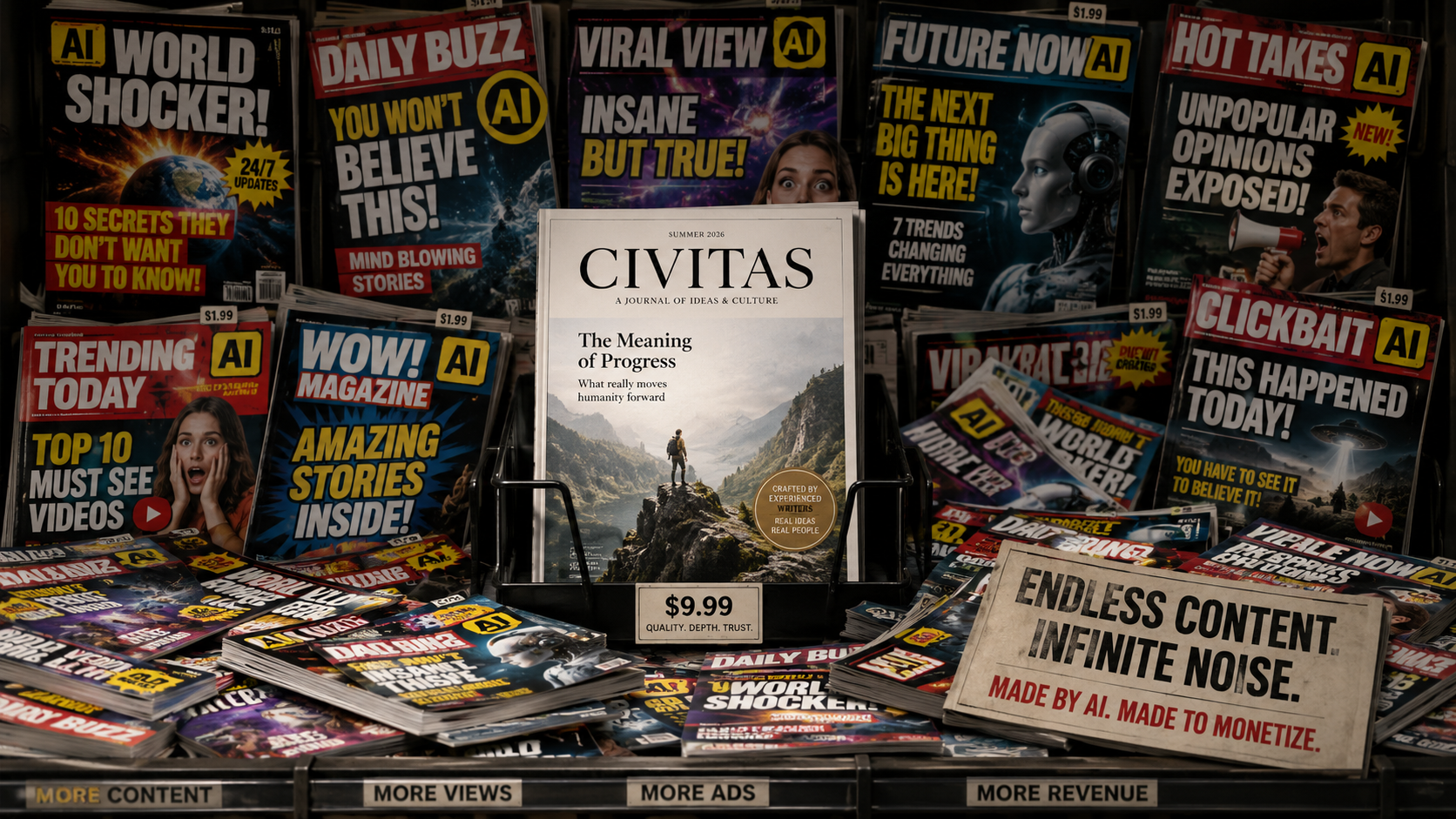
Thesis: We’re moving towards a publishing market where AI content monetized by ads is going to dominate.
How will publishers survive?
Short answer: many won’t.
I know that this idea upsets a lot of people for a lot of reasons, but here’s why it’s going to happen.
Value.
Cheap Sells
Publishers argue that their content is higher quality than anything AI can create. That’s not the winning argument they think it is because people don’t always choose quality. We look at a combination of quality, price, and convenience.
Human creators like to call AI-created content “slop.” Sometimes that’s justified. But those complaints don’t mean much because …
- AI is getting better all the time, and
- It’s not a question of what’s “better.”
That second bullet is the hard one to swallow, but I’m afraid it’s true.
People will choose to pay $1 for the AI slop rather than $10 for the “better” human-created stuff.
You can see this phenomenon in your own life.
A custom shirt is better than a shirt off the shelf, but how many people buy custom shirts?
Art from a skilled human may be better than anything AI can do. But if the human art costs $100, and the AI art costs 10 cents – even if it’s only 85 percent as good…. It’s game over. People will choose (and are choosing right now) to use the AI “slop.”
Consider the image I’m using for this article. I could have hired a human to create something for me, and I have no doubt it would be better. But this image took 10 seconds and cost me almost nothing. That puts a very different spin on what “better” means.
“Better” isn’t what your art director or your editor thinks it means. It’s not a question of quality.
The question is what will people settle for, and all of our experience says that most people will settle for lower quality provided it comes at a much lower price.
Add the Internet
The Internet itself — structurally, at its core — has a strong bias towards “free, supported by ads.”
Take podcast platforms as an example. That was a perfect opportunity to create subscriptions, but it didn’t go that way because that’s not how the tech people think. They assume the podcast will be free and that you’ll earn your supper with ad revenue.
Paid content is a small minority of what gets consumed on the Internet, and it always will be.
“Free, supported by ads” is a tough model for a publisher. You have to pay writers, editors, and artists, and ads aren’t the cash cow they once were.
Many content creators fight against that in many different ways (as they should), but the cards are stacked against them. Our tech overlords have always preferred the “free with ads” model (because they control the ads, and they can get more user information that way), and they’re always nudging (sometimes shoving) in that direction.
“Free, supported by ads” is a tough model when you have lots of salaries to pay, but it becomes easier when AI is doing more and more of the work of creating the content.
Consumers will settle for “good enough,” and they (and the platforms) will prefer “free supported by ads.”
That’s a recipe for AI winning the war.
Some consumers will pay a premium for human-created, higher quality work, just as some people will buy custom-made clothing. But they’ll be rare.
Also, there will be a growing market for cheap, AI-created products that are not ad-supported. AI-written books. AI-created music. And, God help us, AI-created movies – with AI actors.
What’s a publisher to do?
For now, there are two choices.
Option one: outcompete the machine.
Go all-in on AI production, radically reduce your cost of business by replacing humans with AI, and hope that the few humans you still employ can provide a creative edge over the companies that have even fewer (or no) humans.
This can work in the short term, but AI will get better and better, and you’ll be competing against a cost structure that approaches zero run by companies with more capital than you’ll ever have.
The long-term prospects are not good.
Option two: become impossible to replace.
This is the harder path. It means betting on the idea there are some things humans can produce that AI can’t, and that other humans will be willing to pay for it.
Three things fit that description. At least for now.
- A name people trust.
- A relationship with you, your staff, or with other subscribers. A community.
- Judgment that AI can’t match, such as local, boots on the ground reporting.
There will be pockets where human-made work remains commercially strong, especially where trust, status, taste, and identity are part of the purchase. But that won’t save the median publisher trying to live on digital ad economics.
Conclusion
I’m sorry for delivering the bad news, and please don’t think I like any of this. If I could pull the plug and eliminate AI, I’d do it in a second.
But we have to live in the real world, and this, unfortunately, is where things are heading.
Also, while I’m painting a sad picture, it’s not total doom and gloom. AI content supported by ads will dominate, but it won’t be the only game in town.
Clever publishers will find niches, such as special interest publications.
But AI will dominate the landscape.

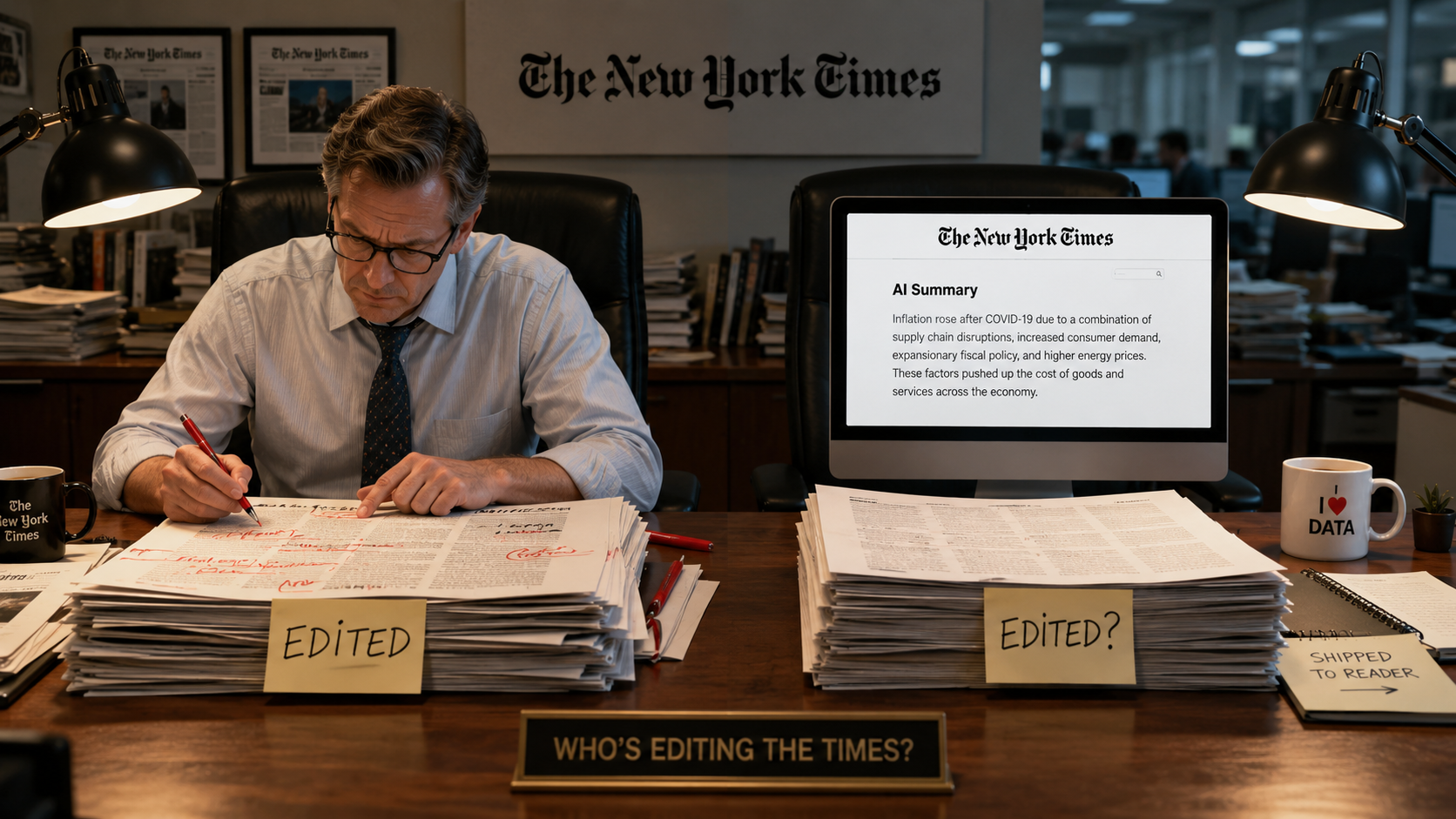


Publishers will have to start by interrogating a much more basic question than strategy or revenue: what actually counts as “content” now?
For most of the web’s history, content meant a packaged output—an article, a video, a podcast—something discrete, authored, and relatively costly to produce. That definition collapses in an AI environment where text, images, summaries, and even “original” reporting can be generated instantly and at near-zero cost. When supply becomes effectively infinite, content itself ceases to be the scarce asset. It becomes a commodity layer.
Content is no longer the product
If AI can generate endless “good enough” explainers, listicles, event previews, and even cultural commentary, then those formats lose their economic defensibility. They are no longer products; they are inputs. Service journalism, SEO-driven articles, and aggregation will function more like raw material in an on-demand distribution ecosystem dominated by platforms and AI interfaces. The value won’t lie in the article’s existence but in how, where, and why it is surfaced.
The scarce asset becomes context and what survives is not content, but context: Why this story matters here, now, for this audience; How it connects to a place, a community, or a shared identity; What to ignore (curation will be as valuable as creation)
AI can generate answers, but it struggles to establish stakes. A local cultural publication, for example, is not just listing exhibitions—it is implicitly answering: “What is worth your time in this city this week?” That layer of judgment is the real product.
Editorial judgment becomes infrastructure, even though it was embedded in content. Going forward, it becomes a visible, standalone value. Think of it less as “we wrote this article” and more as: We filtered the noise; We decided this matters; We stand behind that decision
This is where trust and brand stop being abstract concepts and become operational assets. If users can get infinite answers from on-demand platforms, they nevertheless return to a publisher for decisions.
Content is shifting from output to relationship, and if AI can create commodities, still the durable layer is relationship, direct audience access (newsletters, memberships, events), recognizable editorial voice, and community participation (comments, contributions, offline extensions)
In that sense, “content” becomes a touchpoint rather than the end goal. The article is not the product; the ongoing interaction is.
A concrete example: two outlets publish similar AI-assisted guides to Montreal exhibitions. One is anonymous, optimized for search, and monetized by ads. The other is tied to a known editorial voice, includes a curatorial perspective, and feeds into a weekly newsletter and local event circuit. The informational content may be comparable, but the second creates attachment—and that is monetizable in ways ads alone are not.
The uncomfortable implication is that if publishers don’t redefine content this way, they’ll end up competing on volume and cost against systems that will always be faster and cheaper. That’s a race they cannot win. So the real pivot is philosophical before it’s operational: from producing content → to producing meaning; from publishing pages → to shaping attention; from scaling output → to deepening relevance
The publishers who survive won’t just make better content. They’ll operate as filters, interpreters, and conveners in a landscape where content itself is abundant and increasingly disposable.
I agree that curation is the new currency, but will humans do the creation, or will AI?
An AI agent can curate content for me, specifically. My interests. My biases. No human publisher is going to be able to do that.