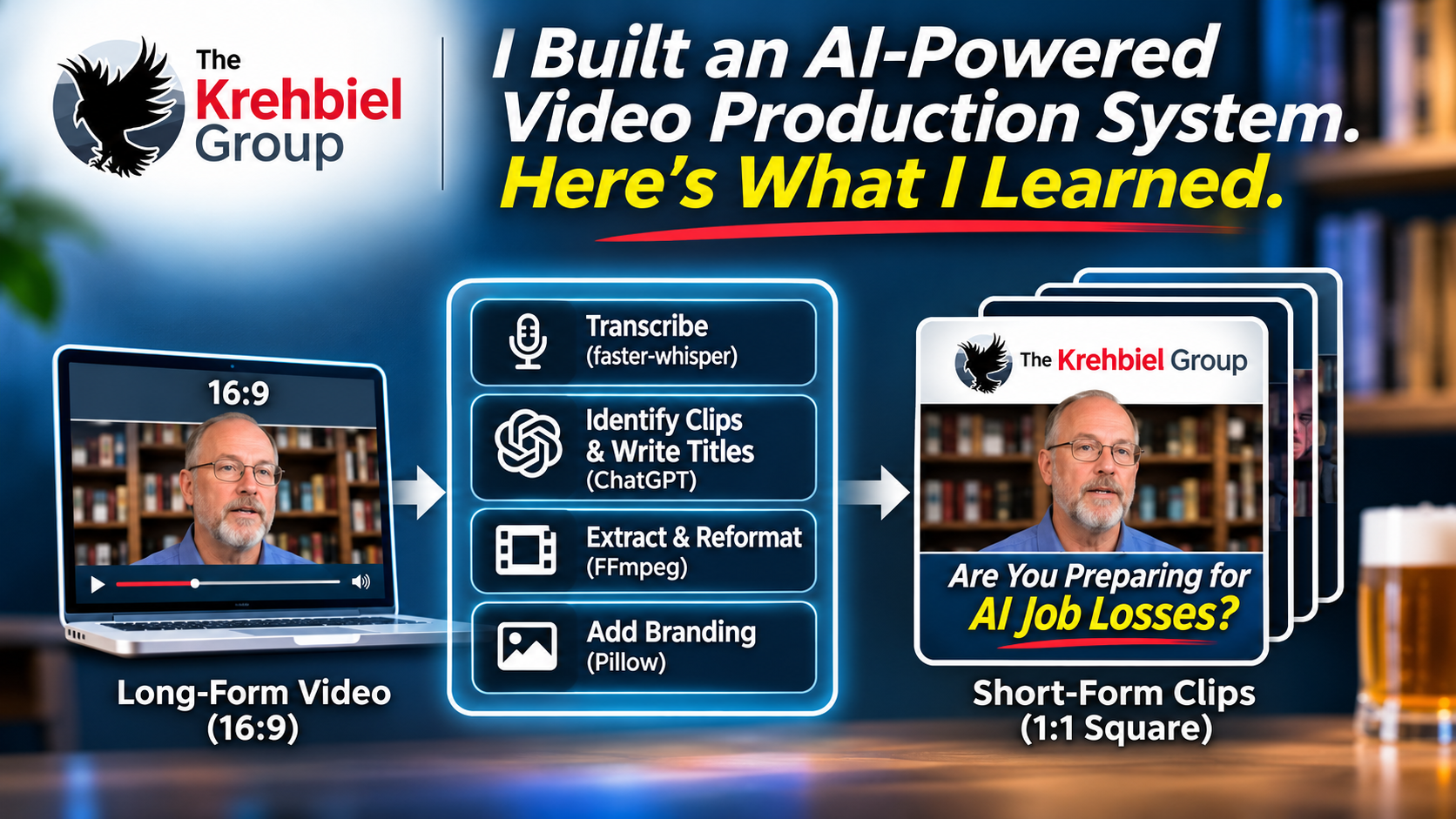
I’ve been using AI to automate some of the repetitive tasks involved in producing short-form videos for social media. Specifically, starting with a longer, 16:9 video, I want to extract short excerpts in a format that will work on a phone — where 1:1 or 9:16 is better.
You can picture the problem this way.
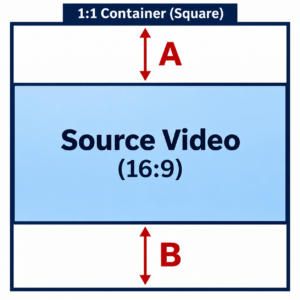
You can’t squeeze the 16:9 video to make it fit, and if you just drop it in, you get empty spaces above and below.
But that’s only part of the problem. How do you select which clips to excerpt? How do you write titles and descriptions for each of these excerpts?
I turned to ChatGPT, and the result was a small, custom-built production system that creates a transcript, identifies promising excerpts, and extracts those sections from the long video, then creates a collection of short clips — with titles and descriptions — suitable for distribution on different platforms.
It wasn’t a one-prompt miracle. There were plenty of mistakes, dead ends, and unexpected complications. But it only took a few hours, and it’s going to save me many hours of production time.
You could summarize the tasks as follows.
1. Create a time-indexed transcript.
2. From that transcript, identify usable shorts.
3. Extract those shorts and reformat them to the new size.
4. Write titles and descriptions for the shorts.
Create a time-indexed transcript
You can pay for this, or you can do what I used to do, which is to upload the video to YouTube as a private video, wait a few hours, then download the time-indexed transcript created automatically by YouTube.
That works, but it breaks up the flow and requires a lot of manual steps. Instead, I used a Python library called faster-whisper to automatically transcribe our long-form videos into time-stamped text files.
From that transcript, identify usable shorts
This is precisely the sort of thing a large language model is good at, so I use ChatGPT for this stage.
I’ve been doing that for a while. ChatGPT identifies promising excerpts, recommends timestamps, and writes headlines and descriptions. I still review its selections and occasionally make changes. I’ve deliberately kept that editorial judgment in the process rather than trying to automate everything.
One important piece of the system is the JSON file created by ChatGPT. ChatGPT doesn’t simply recommend excerpts in a conversational response. It creates a structured file that can be used by the Python application.
Extract those shorts and reformat them to the new size
This is what was using up all my time. After ChatGPT gave me the list of shorts, I’d have to upload the full-length video, find the relative time segment, convert it from 16:9 to 1:1, then fill in those weird gaps at the top and bottom.
For the top, I used AI to create a series of branded images. For the bottom, I used a text block with the title from ChatGPT — which I often edited.
In my new environment, we (me and ChatGPT) developed a custom Python application that uses FFmpeg to automatically extract clips from long-form videos and reformat them into a 1:1 square format. It uses Pillow, a Python imaging library, to add the appropriate branding graphics and headlines, based on instructions supplied in a JSON file generated by ChatGPT.
In other words, using a custom user interface, I point the application to the original, long-form video and the JSON instructions, choose the appropriate branding image, then … hey presto … in a few minutes I have 10 short videos ready to post.
Write titles and descriptions for the shorts
The system does that too. The JSON file from ChatGPT includes all that info and the Python application applies them to the shorts.
The end result is something like this. The 16:9 video is nested inside the 1:1 video.

What this means for publishers
When people talk about AI in publishing, the conversation tends to focus on generating articles, summarizing content, producing images, or replacing editorial labor. Those are important questions, but they’re only part of the picture.
Publishers tend to think about technology in terms of major platforms: CMS, CDP, CRM, ESP, analytics, and so forth. But there are dozens of little gaps between those systems where employees spend hours copying, pasting, reformatting, and moving information around. Fixing those gaps wasn’t worth the investment. AI is changing that. A small custom application that saves a few hours a week is now within practical reach.
Automate the things you can, but retain control over what matters.
In my case, I could just rely on the titles and descriptions from ChatGPT. They’re quite good, and I wouldn’t have any qualms about doing that, but … I still tinker. Sometimes ChatGPT takes an approach I wouldn’t.
The limitations
The system I designed is meant to automate the worst, most tedious part of my workflow. I might continue to automate the pieces I still have to do manually, but at this point I’m not sure it’s worth it. For now, I have a free system that saves me many hours in a week. (Free except for my $20 / month ChatGPT subscription.)
There are several things to keep an eye on.
- AI-generated code is not necessarily good code. It may be inefficient, fragile, or simply wrong. It needs to be tested, particularly when it processes valuable source files or handles sensitive information.
- Automating a bad process doesn’t make it a good process. You still have to think strategically and understand the workflow and what you really want to accomplish.
- The quality of the result depends on the quality of the instructions. This is where the “prompt engineering” idea comes into play. A vague request to “find some good clips” is unlikely to produce great results.
- Human judgment remains important. An AI-selected excerpt may be coherent but uninteresting. A provocative headline may misrepresent the actual conversation. You still need to check your work before you post.
- There is a maintenance question. A custom application can be inexpensive to create with AI, but someone still needs to understand what it does, how to run it, and what to do when it breaks.
What can you fix?
What aspects of your workflow are tedious and uninteresting? Could you build a small tool that automates it?
Think about it, and if you need some help, give me a call.