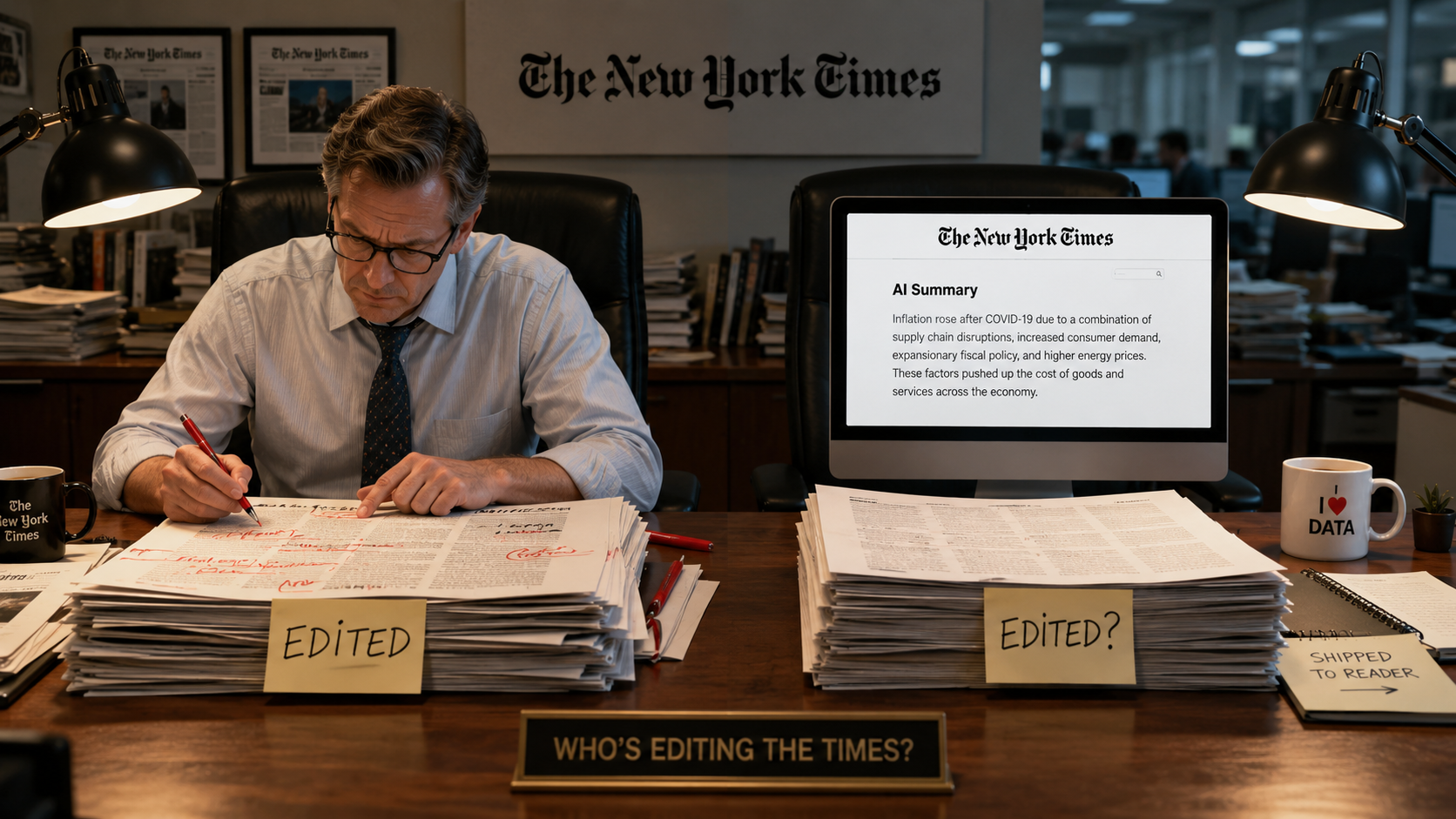
What will publishing look like in the Age of AI? Let’s examine that.
TikTok “gets you” fast. At least that’s what I’m told. I don’t use it.
It’s not doing magic or reading your mind. It’s curating based on your actions. But curation always has a goal. TikTok’s goal is to capture your attention. It does that by learning about you, feeding you, keeping you, and monetizing you.
Tip: Every curator optimizes for something.
- Google optimizes for usefulness.
- Facebook optimizes for interaction.
- Amazon optimizes for purchases.
Content is always curated from a point of view with a goal in mind.
We see the same thing with churches, newspapers, and podcasts. In those cases, they’re not usually chasing a single transaction. They’re more like trusted companions helping you to see the world from within a particular worldview. (But they do pass the plate from time to time.)
Perspective Is the New Scarcity
You can’t sell ice to an Eskimo. You have to sell him something that’s scarce and valuable.
Publishers used to be able to sell access. An energy lawyer in Houston couldn’t get FERC filings, so a D.C. publisher fetched them and sold the convenience. The internet killed that business by becoming an amazingly efficient delivery system.
What the internet can’t deliver is perspective, which is precisely what you need to navigate the flood of content the internet facilitated.
The internet gave us all access to a river of content, but it still relied on human creators to make that content in the first place. Adding AI to the mix turns the flood of content into a tsunami.
In that environment, perspective is more important than ever.
The New York Times claims to publish “all the news that’s fit to print.” That is, from all the “facts” out there in the world, they report the ones that are relevant given their perspective.
Journalism used to pretend otherwise — “just reporting the facts.” That was always a fiction. We encounter billions of facts in life. What we need are the relevant ones, and relevance requires a point of view.
To illustrate, imagine a room in a house. There are an infinite number of “facts” about that room. Now imagine three people enter that room – Sherlock Holmes, a realtor, and a toddler’s mother. They see three very different rooms.
Thinking Tool: Perspective isn’t opinion. It’s a disciplined way of seeing.
A publisher’s job is to find what’s relevant, in context, for a specific audience and purpose. That’s perspective.
Judgment: What to Do With the Facts
You can’t process every fact reality throws at you, and most of them don’t matter anyway. The skill is finding the ones that do – the facts that are relevant within a specific context ordered to a value or goal.
In the middle of a game, a hockey player doesn’t care what brand of skates his opponent is wearing.
Perception is filtered by values and goals before it ever reaches judgment. Some filters are biological. E.g., we tend to notice motion. But skilled perception, like Holmes’s or the hockey player’s, is trained: a disciplined attention to what matters within a specific context. John Vervaeke calls this “relevance realization.”
From there, facts get ranked because relevance isn’t binary. Storm clouds on the horizon matter to a mariner — but a vessel twenty feet off the bow matters more.
Perspective → Perception → Relevance Realization → Relevance Ranking → Judgment
Don’t read that as a straight line. It’s recursive. A strange sound in the woods redirects your perspective instantly, and the whole sequence restarts.
Perspective asks: What am I looking at, and why? Judgment asks: What do I do about it?
Two people can stare at the same “facts” and reach opposite conclusions, because they were never really looking at the same facts. Facts don’t usually arrive in some raw form, divorced from meaning. They often arrive already shaped by a system of value.
Tip: Facts aren’t data points you pick up off the ground. They’re extracted from reality by a process that already assumes what matters.
Someone will object: “Sales are down this quarter — that’s a bare fact.”
Is it?
Down from what — last quarter, or the same quarter last year? If sales dip every Q3 seasonally, “down” means nothing. And why does the quarter matter at all? Because the CEO reports to the board quarterly. That’s a value choice, not a law of nature.
“Sales are down this quarter” isn’t a bare fact. It’s a fact pulled out of a larger process and handed to you pre-interpreted.
I don’t want to be silly about this. Bare facts may exist in some circumstances, and facts should be used to constrain the range of legitimate interpretations. But most of the time, in most situations, a fact only exists as a fact because someone already decided what mattered.
The Prophet Problem
News is extracted from life the same way sales figures are: pulled from an overwhelming, undifferentiated stream of everyday life, according to some editor’s sense of what matters. A business paper and a sports paper looking at the same day extract entirely different “news.”
People don’t usually want data. They want someone to tell them what the data means.
- What’s the takeaway from this week’s games?
- What’s actually happening in real estate?
That’s why we sit through sermons, read op-eds, and listen to podcasts — we want events located inside a larger story, a system of values. We want to know why, not just what. History as “just one damned thing after another” is unbearable. We want a story.
AI is very good at finding patterns in mountains of data. It’s easy to imagine it finding (or hallucinating) hidden stories within the information it’s been given.
Here’s the catch: AI doesn’t have raw data any more than we do. All the information on which it’s trained is already laden with values. So-called “safety guardrails” are then layered on top of that. It’s value all the way down.
So … where are we?
- We’re being engulfed by a tsunami of content.
- Each bit of content is soaked in some system of value.
- We want to extract meaning out of this mess.
Who gets to be the next prophet?
People often think of a prophet as someone who predicts the future, but another role of a prophet is to interpret the present. To put it in a larger context.
That’s the real question for publishers in the era of AI.
Who will interpret the meaning of all the so-called “facts”? Which set of values will govern that interpretation?
Publishers need to lean into perspective and judgment. They need to make the case that human values must give structure and context to our lives.
AI has a role, but humans must be the ones who realize (and publish) what’s relevant.