
Most publishers today are wrestling with the same fundamental problem: search traffic is declining, AI tools are increasingly answering questions directly without sending users to your site, and what used to be a reliable flow of audience from Google search has slowed, and will continue to slow.
A common response has emerged across the industry: build and control your own audience and don’t rely on platforms.
A big part of that strategy involves three familiar tools:
- Registration
- Subscription
- Membership
These terms appear in strategy decks, product roadmaps, and boardroom discussions. They are also commonly misunderstood and misapplied.
This article is about getting those concepts right. Because here’s the uncomfortable truth:
If you don’t own the relationship with your audience, someone else will.
The Core Question: How Do You Get People to Come Back?
The problem isn’t traffic. It’s recurring traffic. Faithful, regular, consistent habits that involve your product. You want an audience that comes back tomorrow—and the day after that.
Registration, subscription, and membership are three of the standard tools, but to use them effectively you have to understand what they mean, not just inside your organization or in publishing chatter, but in the mind of your audience.
Stop Using “Inside Baseball” Language
Customers often don’t understand terms the way publishers do. You have to consider:
- How publishers understand them
- How marketing teams position them
- How customers actually experience them
If those are misaligned, you don’t create the relationship of trust that you want.
How Customers See These Terms
Registration: Administrative, Not Relational
When ordinary people hear the word “registration,” they don’t think “relationship.”
They think:
- Registering to vote
- Registering a vehicle
- Registering a domain name
- Registering for an event
Registration means being accurately recorded in a system.
It’s procedural, administrative, and functional, with very little emotional engagement. It has no value to the customer. It’s something they do as a condition to get value or avoid a fine.
Don’t treat registration like a relationship milestone, and don’t treat it like a thing of value in itself.
Subscription: Ongoing Value for Payment
The word subscription has undergone a transformation. It used to be associated almost exclusively with print media and patronage. Then other businesses wanted a part of the recurring revenue inherent in a subscription, and now we have subscriptions to refrigerator water filters.
The underlying meaning is simple.
I pay for uninterrupted access to something I value.
That could be:
- Netflix
- Spotify
- A magazine
- Coffee deliveries
- Razor blades
The key idea is consistency:
- I pay regularly
- I receive value regularly
The modern twist is that we’re dealing with subscription fatigue. People are overwhelmed by:
- Monthly charges they forget about
- Services they barely use
- The feeling of being trapped in recurring payments
The word “subscription” increasingly carries a negative connotation: a small payment that just keeps happening in the background.
Publishers have to fight against the negative association with the word subscription.
Membership: Identity and Belonging
Membership is fundamentally different.
When people hear “membership,” they think:
- I belong
- I identify
- I’m part of a group
Examples:
- A gym
- A church
- A professional association
- A political party
- A country club
Membership implies something deeper: identity.
It’s not just about access or value. It’s about who I am and who I’m aligned with.
The Key Insight: These Are Not Pricing Models
Registration, subscription, and membership are not pricing models. They are relationship models.
A simple way to think about it:
- Registration = Access
- Subscription = Value
- Membership = Identity
Don’t treat these words as monetization tactics. Treat them as structures for a relationship with your customer.
The “Funnel” Is Not the Strategy
This often gets translated into a funnel:
- Anonymous user
- Registered user
- Subscriber
- Member
It looks clean and feels logical, but it’s misleading. It assumes:
- Everyone should move through the same stages
- The labels themselves are meaningful
- The progression is natural
None of those are guaranteed. First, the words themselves might be misleading your audience. Second, you can’t create a subscription or a membership just by attaching that word to your product. You have to deliver on the promise.
The Exchange of Value
Everything comes back to one principle:
There must be a fair exchange of value.
At each stage, the user is giving you something:
- Registration → email address
- Subscription → recurring money
- Membership → identity and commitment
In return, they expect something specific from you.
Registration Expectations
- Convenience
- Access
- Personalization
They do not want:
- Spam
- Annoyance
- Data exploitation
Subscription Expectations
- Consistent delivery
- Reliable value
- Predictability
If your product is only good occasionally, people won’t subscribe. They’ll cherry-pick.
Membership Expectations
- Belonging
- Participation
- Identity
This is the hardest to deliver—and the easiest to fake.
Don’t call a newsletter signup a membership.
Don’t call a paywall a community.
Focus on the value appropriate to the level of commitment.
The Dangerous Illusions
It’s easy to mistake form for substance, or mechanics for relationship.
| What you think you have: | What you have |
| Audience | Reach |
| Product | Content |
| Loyalty | Traffic |
Don’t focus on the numbers and don’t get fooled by your own marketing. Think about a fair exchange of value and what the customer wants and expects.
No value = no registration
No trust = no subscription
No identity = no membership
Reach, Control, and Friction
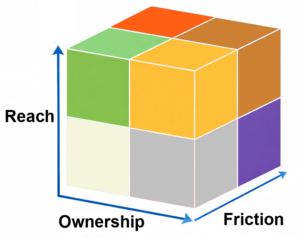 One way to think about your product is by means of my “reach, control, friction” model.
- Reach – How many people you can get in front of
- Control – Whether you own the relationship and data
- Friction – How hard it is for the user to engage
These three variables interact in predictable ways:
- More reach → less control
- More control → more friction
- More friction → requires more value
This is where strategy becomes real.
Example: Ad-Supported Website
- High reach
- Low control
- Low friction
Example: Exclusive Membership Community
- Low reach
- High control
- High friction
Neither is better. They’re just different.
The key is consistency:
- Does your model align with your goals?
- Does your messaging match your structure?
Case Studies: What Works
Let’s look at how real organizations have applied these ideas.
The New York Times: Bundles and Habits
The New York Times realized something critical: people don’t just want news.
They stopped thinking in terms of a single product and started building daily habits:
- Games (Wordle)
- Cooking
- Product reviews
- Audio
They didn’t optimize the old model. They replaced it. They turned a subscription into a bundle of indispensable daily behaviors.
The Guardian: Believe in and Support Our Mission
The Guardian rejected the standard subscription answer to the publisher’s conundrum.
Instead of:
- Pay → access
They chose:
- Believe → support
They kept content free and asked users to voluntarily contribute.
This only works because:
- The value is clear
- The mission is clear
- The relationship is based on trust
Stratechery and Substack: The Power of the Individual
Stratechery proved that people will pay for insight from a person. Substack scaled that model into a platform.
- Direct relationships
- Email-first distribution
- Creator-driven trust
This represents a shift:
- From institutions → individuals
- From brand loyalty → personal trust
The Athletic: Indispensable Content
The Athletic succeeded by doing something simple but very hard.
- No ads
- Deep coverage
- High-quality writing
They made their content indispensable to people who love sports.
Harvard Business Review: Registration as Onboarding
HBR uses registration strategically. It’s the entry point to a deliberate onboarding and behavioral conditioning process that leads toward subscription.
Registration becomes a behavioral bridge.
Patreon: Membership Done Right
Patreon turns casual support into ongoing identity:
- Early access
- Extra content
- Direct connection
They built membership around emotional investment with the content creator.
Case Studies: What Fails
Now the cautionary tales.
LA Times: Membership Without Meaning
They added perks to a subscription and called it a membership. It was the old product plus coupons. They had a mismatch between promise and delivery.
Mic: No Unique Value
They tried to move to subscriptions without offering anything exclusive.
People won’t pay for what they can get for free.
Facebook: Platform Dependency
Publishers were encouraged to build subscription businesses on Facebook.
The problem:
- Publishers get revenue
- Publishers lose the relationship
If you don’t own the relationship, you don’t own the business.
Apple News: The Buffet Problem
They bundled everything into one subscription. There was no clear identity and no clear reason to want it or to care.
The odd thing about this one is the contrast with Netflix, which succeeds with a similar model. Why? That’s an open question—but it likely comes down to how people relate to the content.
Sports Illustrated: Breaking Trust
They replaced trusted journalism with AI-generated content. They lost credibility and accelerated churn.
When you break your promise, people leave.
BuzzFeed: No Identity
They tried to build membership on casual, viral traffic.
User reaction:
“I just came here for a quiz.”
No identity → no membership.
Gannett: Friction Without Value
They added registration walls with no benefit.
Translation:
“Give us your data so we can keep doing the same thing we’ve been doing.”
CNN+: No Reason to Exist
They launched a paid product without answering the core question:
Why do I need this?
They couldn’t, so it failed.
The Common Thread
All of these examples—good and bad—point to the same conclusion:
Registration, subscription, and membership only work when:
- The value is clear
- The relationship is real
- The identity is meaningful
And most importantly:
If the product doesn’t match the promise, it fails.
Final Thought: Don’t Force the Model
The biggest mistake publishers make is treating this model as a marketing progression without simultaneously treating it as an increase in value and relationship.
Ask yourself:
- What are we actually delivering?
- What does the user want?
- What kind of relationship makes sense here?
Just because you want the economic benefit of a subscription or a membership doesn’t mean you have the product to support it.
Align your product with customer expectations—both in terms of the language you use and the value you deliver.




One thought on “Registration, Subscription, Membership: Why Publishers Get This Wrong and How to Fix It”