This is not a happy article. This is not positive, rah-rah stuff.
This is reality. And it’s scary.
If you’re willing to indulge me, here we go.
My Vibe-Coding Experiment
Let me start with an experiment I did.
I like to listen to a news podcast in the morning while I’m cooking my omelet. I like a daily news podcast that’s about 10 to 15 minutes long. But I’d like to have the news from multiple sources.
If you listen to one site, you don’t hear the pushback from opposing views. I wanted something that gave me the left, the right, and the center—mixed together—so I’m not falling into an interpretive spiral.
My solution: I got on ChatGPT and vibe-coded a test system. Here’s what it did.
- Pulled RSS feeds from several news sites I trust
- Selected stories I’d be interested in (based on what it knew about me)
- Summarized them
- Added pushback from other perspectives
- Turned it into a transcript
- Converted that transcript into audio
It was pretty great, and I sent it to some friends who couldn’t believe it was all from AI.
They said, “Why do you need humans anymore?”
And that’s the scary point I want to make today.
My AI experiment replaces multiple websites and multiple podcasts. I get a balanced “what do I need to know today?” podcast, customized to me.
Here’s the crucial thing: the publisher is totally out of the loop.
The AI is grabbing that information, summarizing it, adding pushback, and delivering it to me—without me ever visiting the publisher’s site.
No browsing.
No clicking.
No comparing sources.
Why This Matters
There’s tons of content out there, but there’s still only 24 hours in a day, and I can only spend so much time listening to podcasts. AI helps me to focus exactly what I want in the time I want to spend.
Samantha Is Coming
If you haven’t seen the 2013 movie Her, you should.
In that movie, Joaquin Phoenix has an AI assistant—Samantha—who helps him out with his life. Samantha sorts his emails, manages his finances, and makes his daily life a lot easier. She also gets to know him, learns about him, and customizes things to his interests.
That’s what’s coming.
Everybody will have their own AI agent:
- It will answer questions
- Help with finances
- Do shopping
- Filter information
The old behavior (using Google search) was:
Search → Scan results → Click → Read → Repeat
The new behavior is:
Ask → Receive → Move on
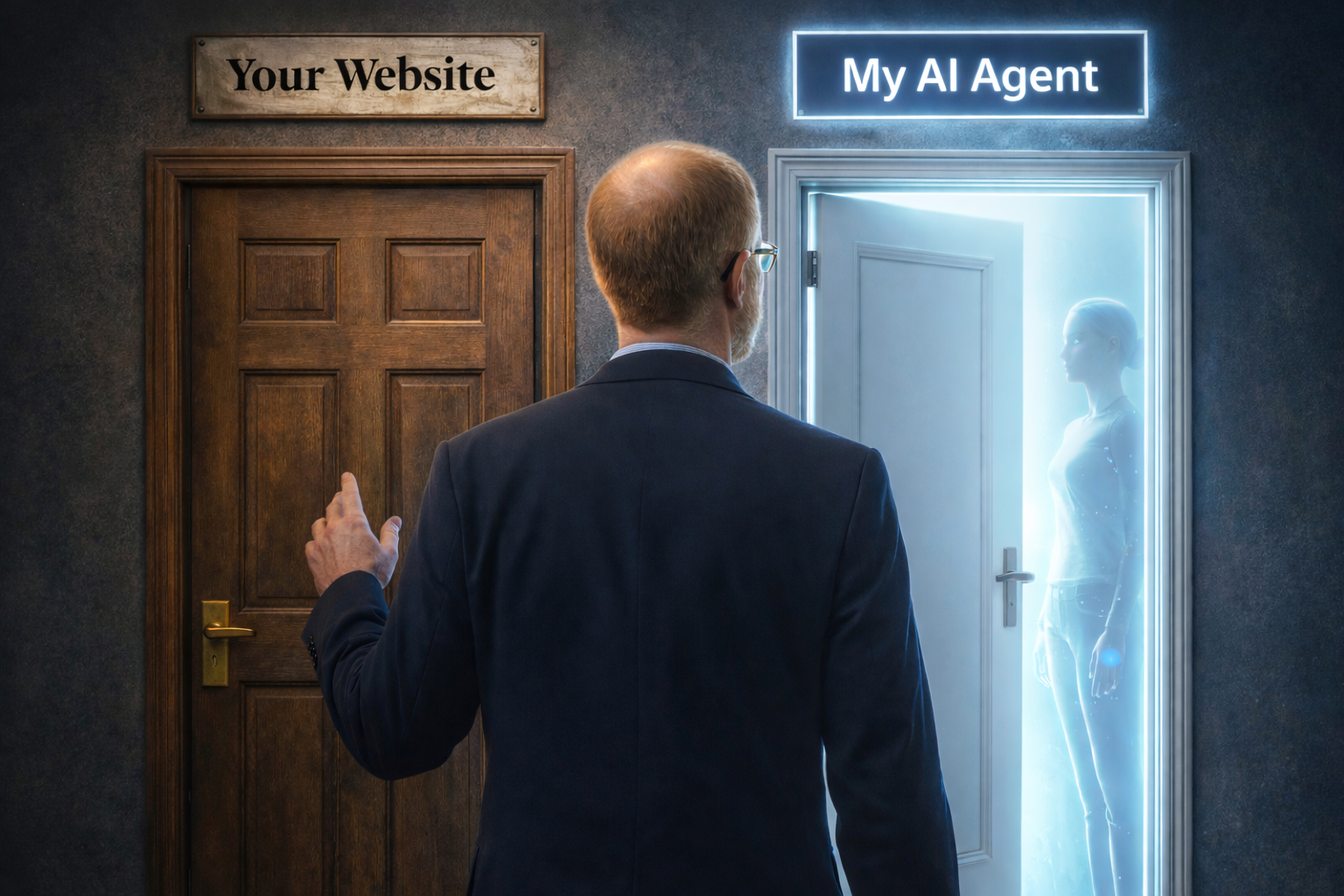
And here’s the most important part: the publisher isn’t even in the loop.
AI will become the front door to information. Not search engines. Not websites. Not podcasts. Not magazines.
Reality Check #1
This is not happening tonight.
- Websites still matter.
- Email still works.
- We’re not sure how fast adoption will happen.
But behavior is shifting, and once that shift happens, it will be hard to reverse, and there will be little room for publishers.
How We Got Here
We made a decision years ago to put content online for free. That decision has had long-lasting consequences.
First, it trained users to expect free content.
Second, it required search engines to index our content—giving them control over how it’s used. (With no contract!!)
Third, it led to an ad-supported model where:
- The platforms controlled the data
- The platforms controlled the customer
- The platforms controlled the monetization
Publishers chose traffic over ownership. That was a mistake.
To understand why, you have to know the big tech mantra.
All your customers become our customers.
We’ve seen this before. Apple tried it with magazine subscriptions. Google did it with search.
You get reach. You get pennies for your content. You lose control of the customer relationship.
The Google Era
Search used to be the gatekeeper. To survive, publishers had to:
- Optimize for Google
- Follow Google’s rules
- Compete for visibility
Some companies built businesses around this model, such as entire websites devoted to how tall celebrities were, or who was married to whom.
Now Google just gives you the answer. No click required. Those websites are irrelevant.
AI Will Go Further
Google has slain its thousands. AI will slay its tens of thousands.
What gets wiped out?
- Aggregation
- Summarization
- Tech help
- Legal explanations
- “Ten best…” lists
- Recipes
AI is already eroding search traffic, and it will continue to do so. It will also erode direct traffic because why should someone bother with your website when AI can just answer their questions?
What’s Left (For Now)
For now, humans still have:
- Opinion
- Deep expertise
- Subjective experience
- Community
- Judgment
AI doesn’t truly have those—at least not yet. Publishers need to lean in to what AI can’t do.
That means:
- Personality
- Voice
- Niche expertise
- Lived experience
Think about people who’ve built media empires around themselves, like Megyn Kelly or Joe Rogan. That’s a short-term path to survival.
But … New Technologies Create More Opportunity!!
Historically, that’s true. New technologies displaced jobs but also created new ones.
- Cars created suburbs and tourism
- Electricity created the night economy
- The internet created e-commerce
AI is different. It reduces friction and makes everything faster and easier—but it doesn’t increase attention or demand. There are still only 24 hours in a day.
Here’s the key problem:
AI doesn’t create jobs it can’t also do.
AI will replace hundreds of millions of jobs and create dozens of them. The social and economic impact with be catastrophic.
What’s Left for Humans
In publishing—and beyond—what’s left is:
- Original reporting
- Experience
- Empathy
- Taste
- Innovation
- Opinion
- Intentionality
- Morals
- Wisdom
Those are hard to automate. At least for now.
What Happens to My Content?
Some of your content is at risk—that is, the content AI can do. But some becomes more valuable.
Examples:
- Hyperlocal reporting
- “How to fish the Severn River on a kayak”
- Lived experience
AI can’t be on Main Street. AI can’t experience something.
That’s your opportunity.
But then comes the next question:
Do you sell or license your experience to AI?
No. Build a relationship with your audience—while you still can.
Reality Check #2
As of right now:
- Google still matters
- Email still works
- Websites still matter
- Magazines still matter
- Brands and personalities still matter
But over the next few years, expect:
- Fewer clicks
- More AI summaries
- Less direct traffic
- More “good enough” answers
“Good enough” is a real threat. Some content creators like to complain that AI makes slop, makes mistakes, and misses nuance. Okay, but if the answer is good enough, the user is done and moves on.
What To Do Now (Next 6 Months)
So what can you do right now?
- Own the relationship
Especially through email - Create content AI can’t
(This pool will shrink over time) - Invest in niche, original experience
- Build a recognizable voice
You want someone to say:
“I want to know what you think about this.” Not just “what’s the answer?”
Final Thought
AI makes average content simple, and that makes distinctive content more valuable.
Your goal is simple:
When someone thinks about your topic, they think about you.
Because here’s the question that should keep you up at night:
When everyone has Samantha in their ear…
What’s your role?
What are you providing that they’re not already getting?
I told you this wasn’t going to be a happy talk. It’s depressing. It depresses me. But it’s better to face the monster than to be caught from behind.




I always thought the Her in “Her” was his ex-wife