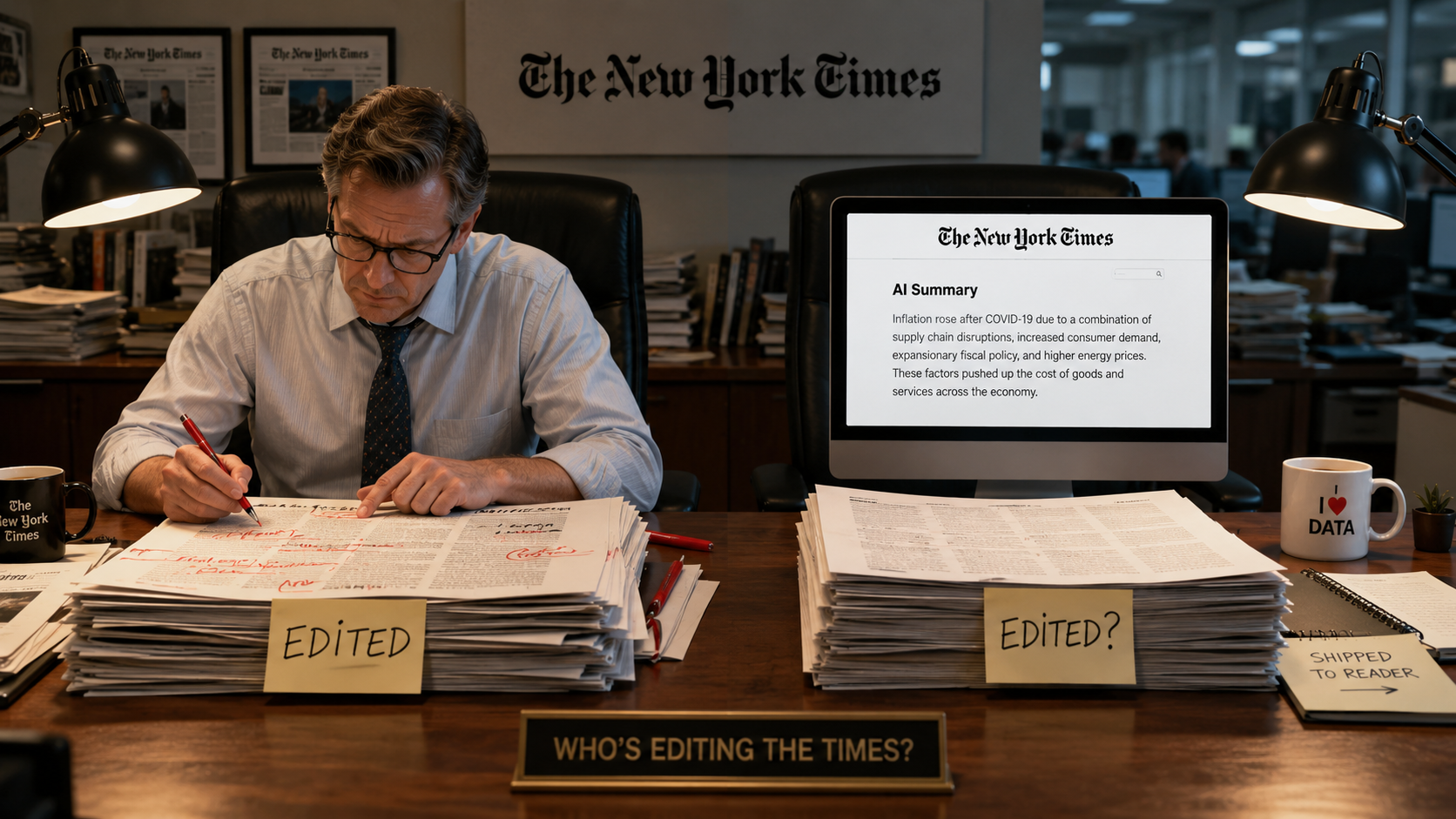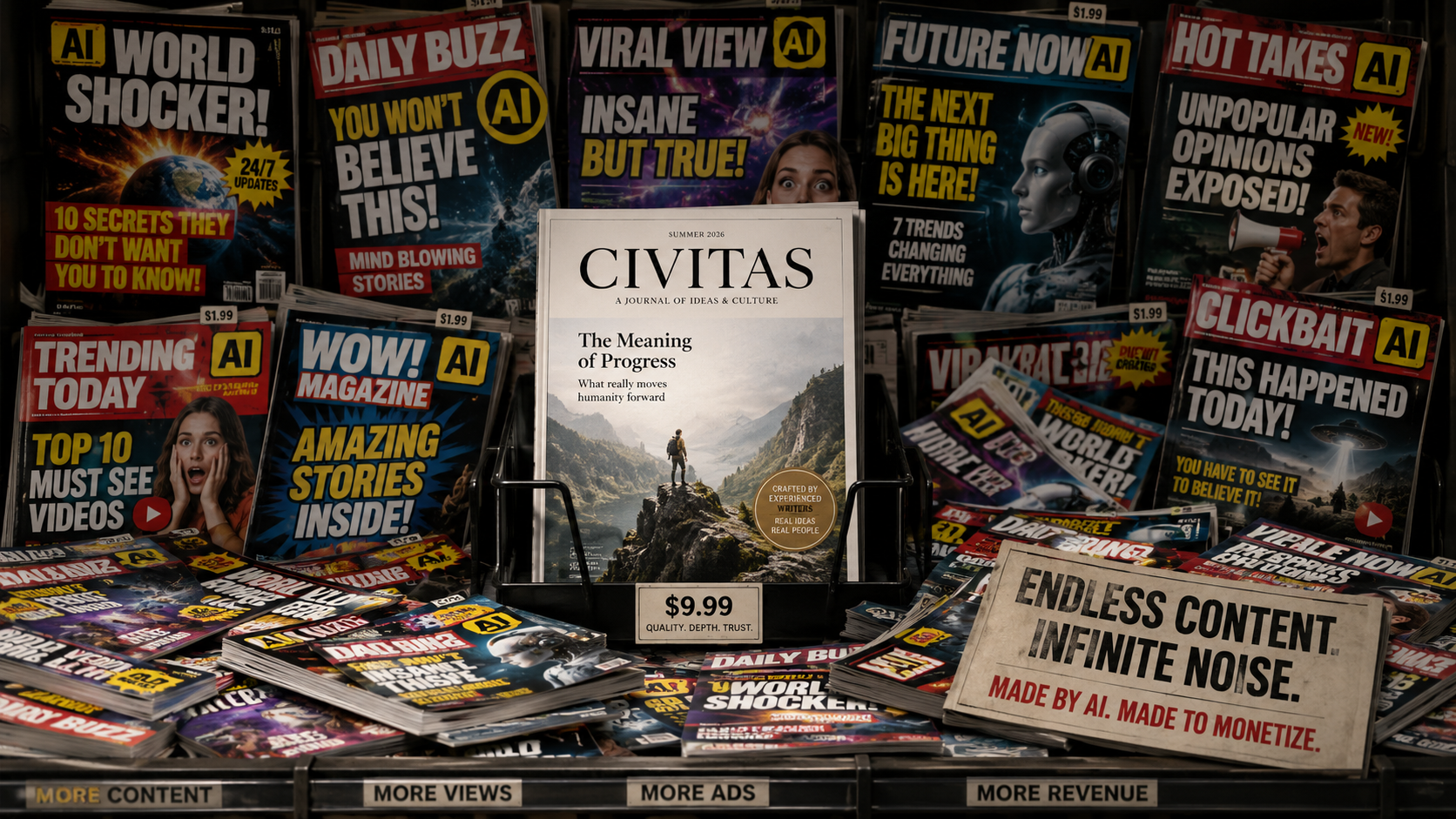
I’m afraid I misled the Chinese about publishing workflows. I’m not sure their economy will recover.
A friend in the publishing industry works for a company that intended to move an old, print-centric production system into a new, more digital-first environment. That effort reminded me of some talks I gave to Chinese businessmen about production workflows. The old model, I told them, looks like this.
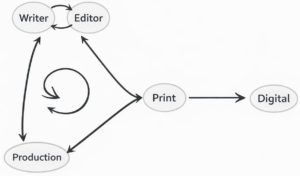
Editorial works on a concept until it’s about right, then hands it off to production. Production lays it out for print, then it goes back to editorial for review. After a few rounds of this, the print version is finalized. Then it’s converted to digital. (Believe it or not, some places still work that way.)
That model is inefficient for a few reasons, not least because the print-to-digital conversion is often a mess. Also, the digital team sees that the writing is done and wants access. “Can we please have the 99 percent ready copy earlier?”
The better model, as I explained to my Chinese friends, goes like this.
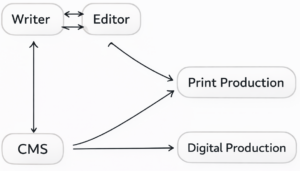
Editorial finalizes the content in the CMS, which feeds both print and digital production. The content might have to be tweaked for each medium, which – while it’s a good and necessary idea – makes editorial nervous because they often lose control of the final tweaking on the digital side.
The problem goes deeper
Something like this change is happening (or has happened) everywhere, and it’s a good thing, but there’s an important conceptual issue we have to wrestle with. The second model fails to account for the effect of the medium on the content.
Content isn’t some disembodied thing that’s incarnated in print, voice, or digital. The structure changes the information.
“Digital-first” can make the mistake of assuming that content exists independently of format. It doesn’t. The format isn’t just a wrapper, or a means to deliver the content to an eyeball (or an ear). It’s part of the idea.
To illustrate the importance of format, imagine you’re playing poker with some friends and you want to create a new game. You can’t do anything you imagine. You have 52 cards with four suits of 13 cards each. Your idea has to live within those restraints.
In the same way, if you want to produce a song for the radio, you can’t drone on for 30 minutes. Movie studios won’t accept films beyond a certain length, or that won’t fit on their screen. Board games have to fit inside a reasonably-sized box.
This sounds like a bad thing. “Why can’t I be creative and do what I want?”
Physical restraints can be good. Creativity without bounds results in slop. Accommodating an idea to an existing structure often results in a more refined and effective product.
Let’s go back to digital and print workflows. Their different assumptions affect how content is created.
A digital article doesn’t have to fit in a defined space while a print article often does. The rules about accompanying images, charts, pull-quotes, and such are different in different mediums and affect how content is written. Most importantly, mistakes on the print side are expensive and embarrassing, while mistakes on the digital side can be fixed relatively easily. (Except in email!)
Because of these differences, some digital publishers assume something like a “ready, fire, aim” approach. You can always fix your post later. (I don’t recommend that attitude.)
The production workflow is more like “Ready, aim, reconsider, check it again, send it to the copy editor one last time, sleep on it, sweat about it … run it by a friend … fire.”
The digital first mentality has a Gnostic character to it, as if the soul (content) is independent of the body (format), or as if the idea exists independently and the medium is just a vessel.
It doesn’t work that way. Layout isn’t an afterthought. It’s an integral part of the content.
Now let’s revisit the diagrams above. What’s the practical effect of all this?
First, “content” isn’t a product until it takes a form, whether that’s a printed page, an email, a podcast, or any other distribution channel.
Second, there’s an editorial and an artistic component in adapting content to structure. Don’t underestimate that.
The conclusion from those two points is that we have to think of “content” almost as a raw material that has to be shaped and formed before it becomes a publishing product.
What should publishers do?
- Don’t think of “content” as a finished product, ready for any medium, nor yet as a liquid to be poured into any mold.
- Treat adaptation to the medium as part of the creative work.
- Respect print constraints. They’re there for a reason.
- Don’t let CMS design dictate editorial thinking.