For years, publishers could rely on search engines to deliver reach with little friction. The challenge was to monetize that audience, which sometimes meant capturing an email or login.
As search has declined, publishers want to “own their own audience,” which often means e-newsletters, memberships, and apps. But sometimes that’s too much trouble for the consumer. What publishers need is a way to find the right balance.
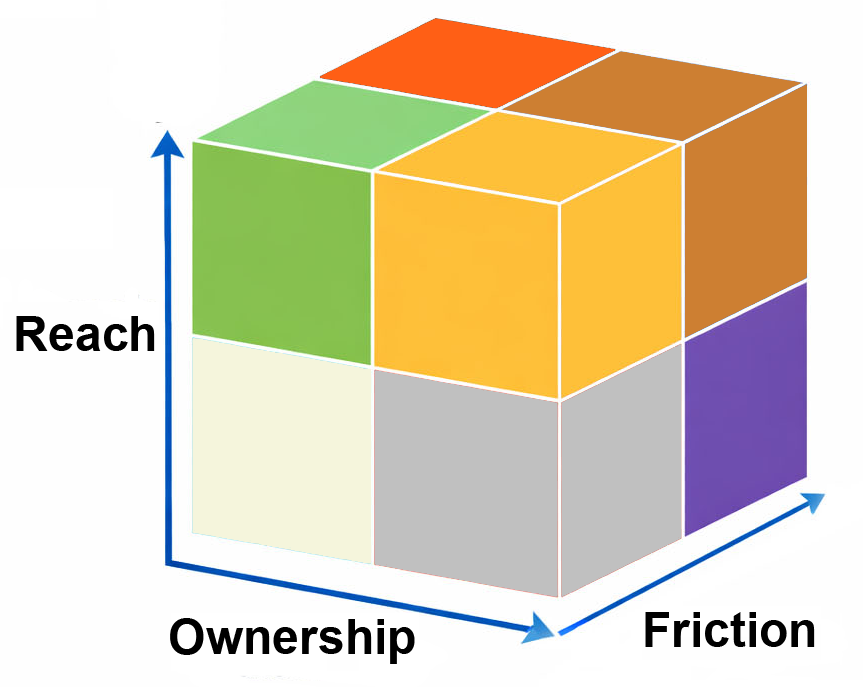
To make sense of this, I use a simple mental model: the Reach / Ownership / Friction Matrix.
Reach is how many people the channel can attract.
Ownership is whether you have a direct relationship with the customer, rather than one mediated by another service or platform.
Friction is how much of a pain it all is.
It’s tempting to think that you want to be in the near top right corner (the one in gold). High reach, high ownership, low friction. That’s a great place to be, but it isn’t always realistic, and it isn’t always the right strategy. Friction is often bad, but it can signal exclusivity.
In the same way, reach can be good, but sometimes you want a very targeted audience. Reach doesn’t matter that much.
You’ve been thinking about this so I’m sure you get the picture.
A former boss sold me on the value of mental models. He kept notebooks full of them and used them constantly in strategy discussions.
Sometimes a model pushes you towards a particular quadrant (or in this case, octant), but other times it just illuminates the trade-offs.
Some of the cells in my matrix are duds. It’s hard to imagine a good product with low ownership, low reach, and high friction.
Now imagine a service with high reach, high ownership, and high friction. That could work when it’s hard to get precise lists for your prospects, or even to identify them ahead of time. You need a big net, but the nature of your service requires an active customer, so you want high ownership. But you don’t want to waste your time on unqualified prospects, so high friction is a good idea.
You might name this one, “Many are called, few are chosen.”
You can also view the octants in my matrix as stages in audience development. High reach, low ownership, low friction is how you attract prospects that you then try to convert to high ownership.
The point of this model isn’t to say which approach is right. It’s to help publishers understand where a tool, channel, or product idea fits in an overall publishing strategy.
Think through the use cases for each octant in the matrix, then take another look at your publishing strategy. You may find that the problem isn’t execution — it’s that you’re trying to occupy the wrong part of the cube.