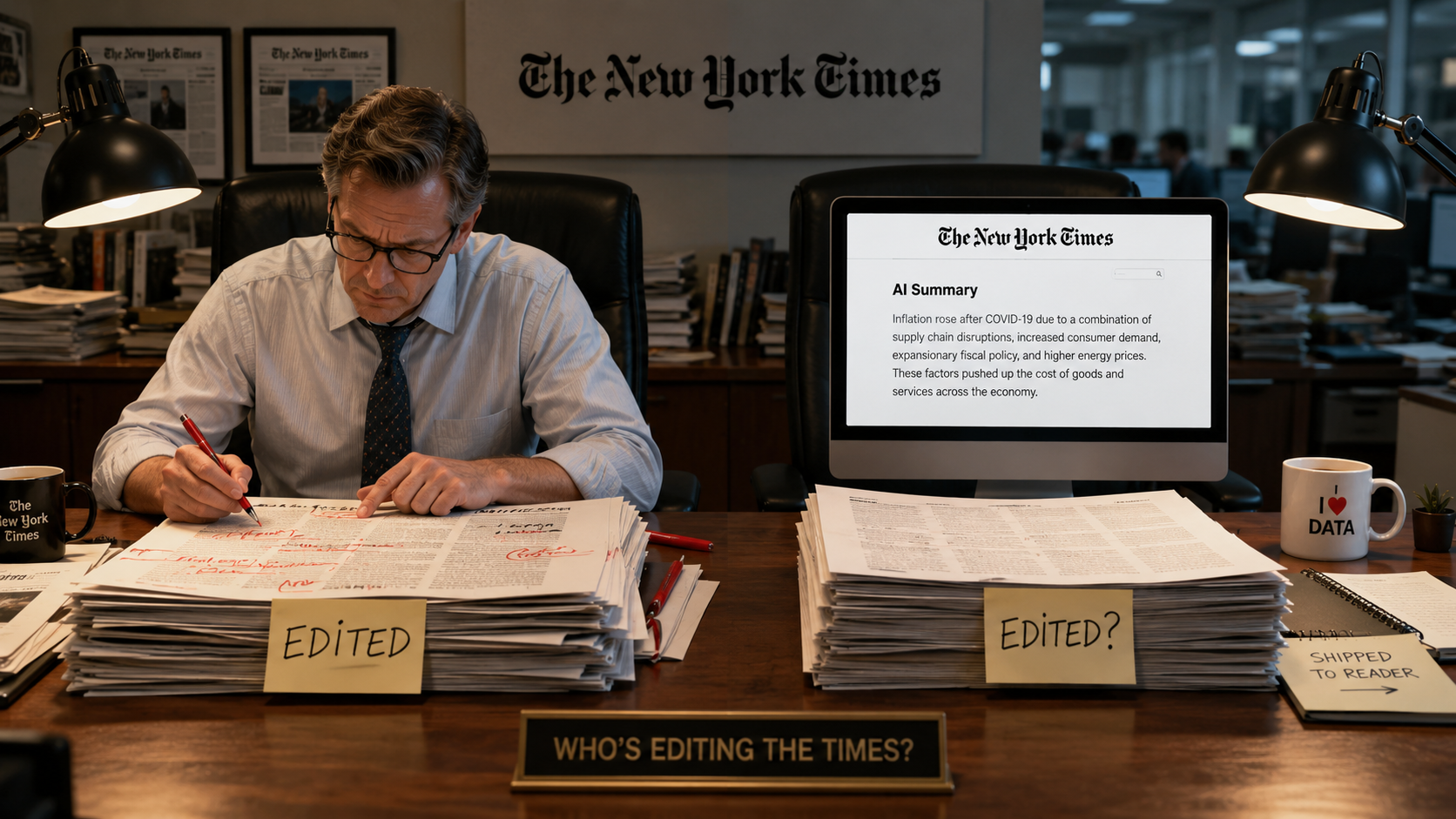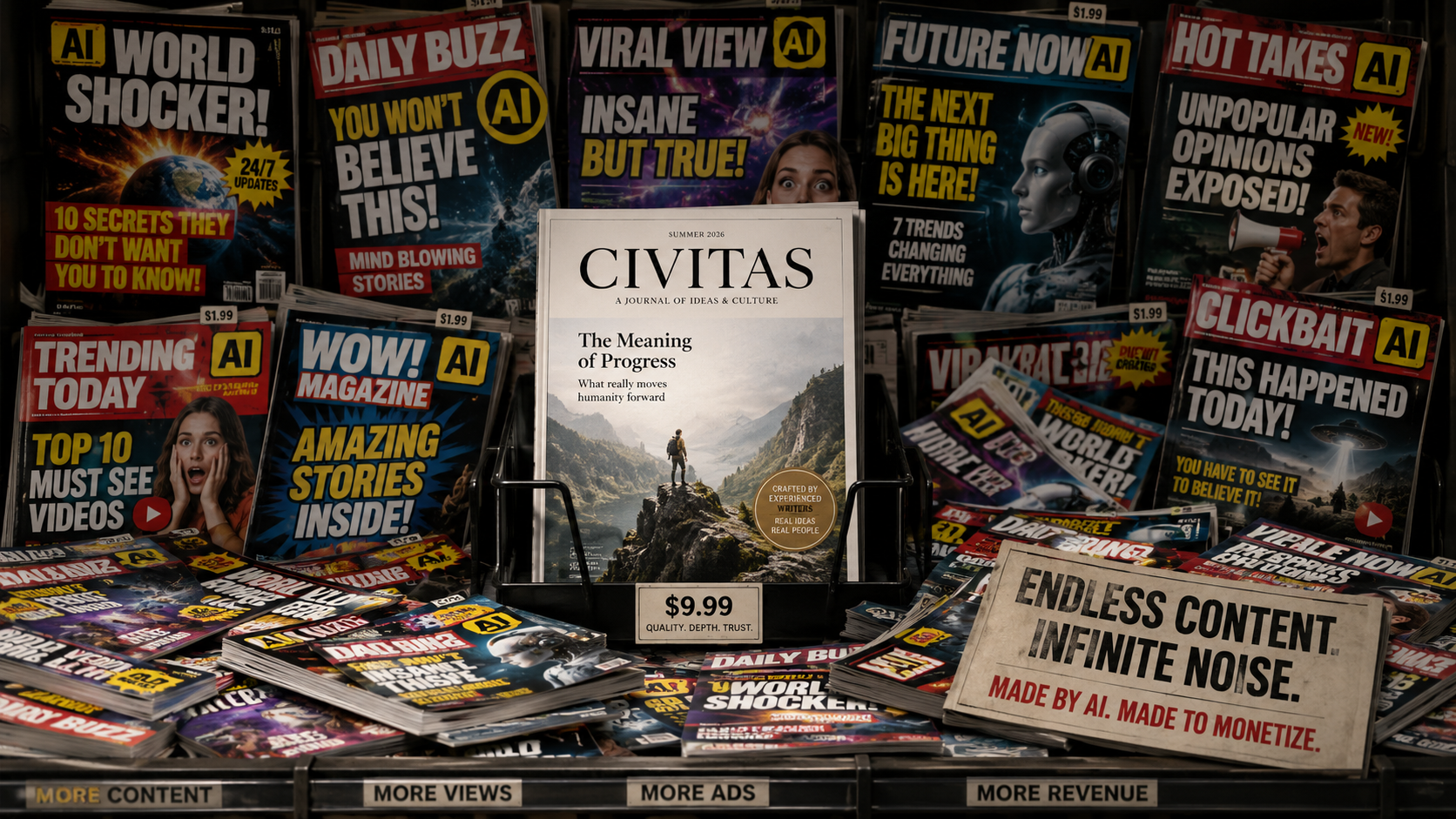
You can make the fastest, most readable website with the perfect design, elegant search features, and your own custom GPT and it still won’t be more convenient than a generic AI chatbot — because your readers’ workflow has fundamentally changed.
Here’s the old workflow.
Search, click, scroll, skim, avoid ads, extract the answer from a wordy article that wants to keep you on the page.
Here’s the new workflow.
Ask, get an answer.
The best user experience on the planet can’t solve that. You can’t sell a buggy whip to a car owner by making the buggy whip better, and writing an article to answer a question is the modern equivalent of a buggy whip.
If I want the best lasagna recipe, I’m not going to go to a recipe website. I’m going to ask ChatGPT. That’s where we’re headed and publishers need to adapt to that reality.
The wrong way to adapt
Complain about copyright violations. Yes, it’s tempting, and it makes you feel virtuous. I’ve done it, because it is a legit issue. But publishers aren’t going to win this one. It’s a dead end.
Monetize the discovery of your content through AI. This is also tempting, but also wrong-headed, for a couple of reasons.
- AI doesn’t work the way you think it works. It’s not really using “your content” in a way that’s going to hold up in court. Yes, there have been some minor tremors in that direction, but that’s a distraction.
- Even if AI is currently using your content in an unfair way, our tech overlords will just find another way to get what they need to answer user questions.
This is the hard truth. People never wanted the article in the first place. They just wanted the answer. The article is the friction they had to overcome to get the answer.
Anything along these lines will be replaced by chatbots.
- “How to cook a soft-boiled egg”
- “Maryland tax brackets 2025”
- “How to soothe a child who’s teething”
- “Symptoms of vitamin D deficiency”
Getting those answers from AI is simply easier, so that’s what people will do. You can complain about accuracy if you want. Nobody cares. AI is accurate enough on such questions.
The right way to adapt
Start with the working hypothesis that everything you’re doing right now is outdated – because it probably is. It was developed in a world that doesn’t exist anymore. It was designed for horses and now we have cars.
I hate to say this next part because a big part of me wants to lead mobs of radicals down to the local data center and mount powerful electromagnets on all the servers. But that doesn’t help anybody, so here’s what the angel on my right shoulder has to say.
Don’t fight the new reality. Find the right wave and surf.
Focus on content AI can’t displace, and remember this: unless you’re writing fiction (or maybe comedy, or satire, where reading is part of the pleasure) nobody wants to read your article. Writers are in love with articles. Readers aren’t. The article is the obstacle to the goal. The article isn’t the six-pack abs, it’s the crunches. It’s work, and, increasingly, it’s an irritation.
Pardon the French, but if you still read books, try this one: Nobody Wants to Read Your Sh*t.
What then? Do we all retire our keyboards and give up on publishing? Not yet. There are still categories that AI can’t replace (until next Thursday). Focus on those things.
- Analysis, essays, and opinion
- Deep reporting
- Deep local knowledge
- Personal writing
- Community-oriented content
- Lived experience
- Contrarian positions
Think of this triad: taste, trust, community.
You can also be paternalistic. “This is what you need to know today. We’ve sorted the tsunami of bullshit and we’ve boiled down the good stuff to what really matters.” AI can’t do that.
Focus on formats AI can’t do well. (At least not yet.)
- Podcasts
- Videos
- Live streams
- Webinars with Q&As
- Events
- Courses
One last thing about answers. I’ve been hard on answer articles, but I mean that in the sense of “what should I plant this winter” or “what’s a Roth IRA?” Expert answers that include judgment, taste, or something a computer can’t provide, are a little different and can retain their value in the age of AI chatbots. But still, nobody is going to come to your website to get it.
This isn’t the answer
I don’t have the perfect answer to the crisis we’re going through right now. If I did, I’d start that business.
I’m trying to put the crisis in some perspective and to warn you away from dead ends.
“Radical” means “going to the root or origin.” These are radical times – the ground is moving under our feet – and we need radical thinking and radical solutions.
Somebody is going to come up with the right business model in the midst of this chaos. I hope this article has nudged you towards finding it. And when you do, send me a case of bourbon. I’m not picky about brands.