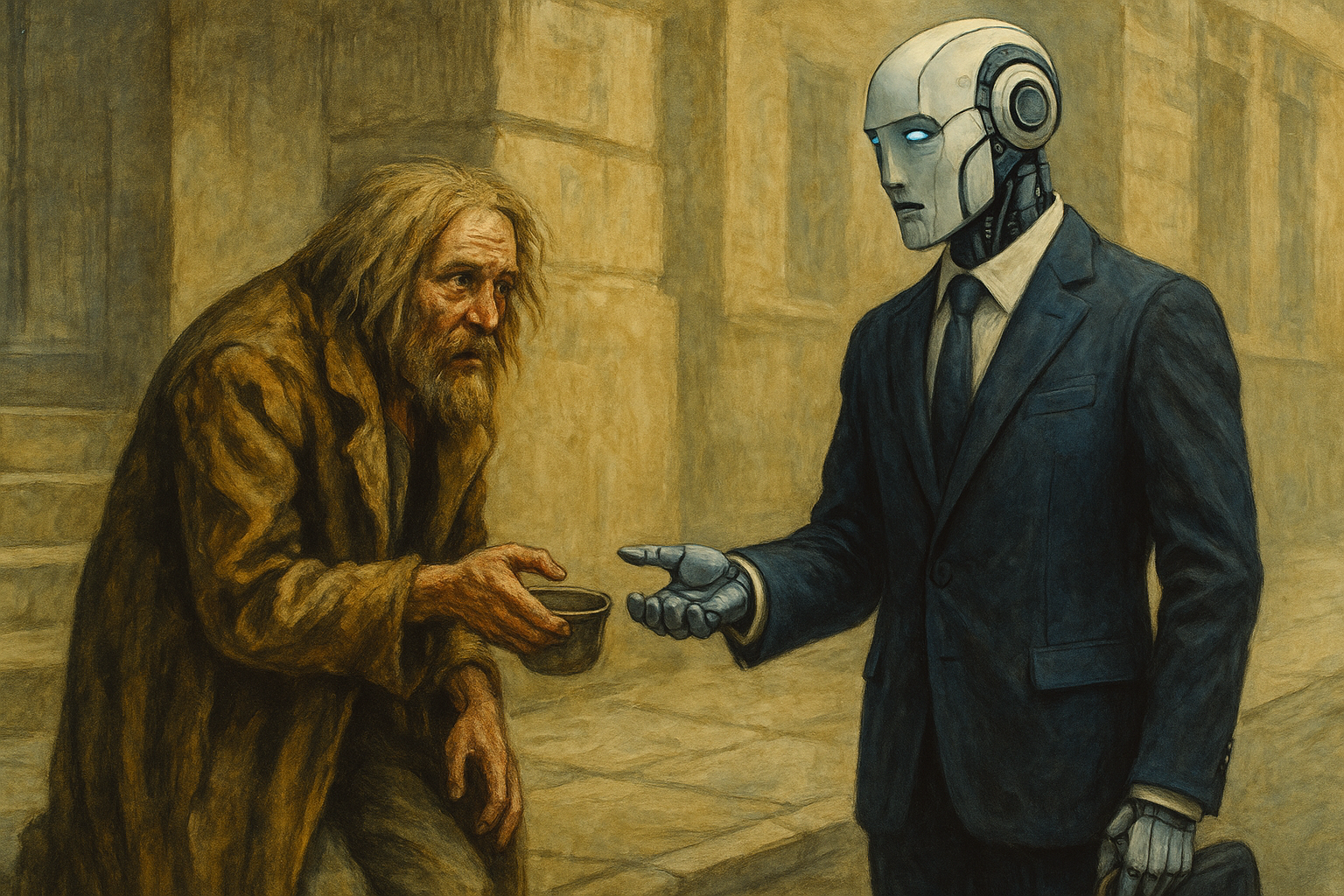
Okay. It still needs to be said.
AI will create a horrendous unemployment problem by eliminating millions of human jobs. Self-driving trucks on their own could destroy more than 3 million jobs. AI will also replace tellers, cashiers, accountants, marketers, copy writers, illustrators, …. The list goes on and on.
Crippling social ills will accompany the job losses. More depression. More suicide. Fewer marriages. More divorces. More kids in poverty.
The tech geniuses tell us that AI will usher in a new era of wealth and prosperity, but have you seen the economic model? Has anybody explained how that’s supposed to work?
How are you going to be wealthy and prosperous after AI has replaced your job?
The story of a rosy AI-led future is smoke and mirrors. There is no plan, and nobody can make up even a decently persuasive explanation for how AI is going to make everyone prosperous.
In short, AI will mess things up … badly. The tech barons will rake in the dough. Most of the rest of us will be left with no jobs. It’s a catastrophe in the making.
But I’m a Hypocrite
At the same time, I love AI, and I use it all the time. Recently I’ve been using AI to create images for children’s stories. (See grandpagoose.com.)
People have asked me why (if I think AI is such a threat) I don’t hire a human artist, and the reason is simple. The project isn’t worth it at that cost, but it is worth it if I use AI. It’s a choice between doing something — with my $20 / month AI subscription — and not doing something.
I’d rather do something.
AI has lowered the barrier to entry for content creation so that people like me — who can’t draw a circle without tools — can create pretty interesting things.
That makes me a hypocrite, and I know it. My only defense is that my individual choice won’t have any effect either way.
The “promise of AI,” if there is one, is that AI will lower costs and lower the barrier to entry into many markets. For example, it makes it possible for me to make my videos for my grandchildren.
It may also …
- Make better medical diagnoses — and put doctors and medical technicians out of work.
- Design better microchips — and put engineers out of work.
- Give customized exercise advice — and put trainers out of work.
And on and on.
Lowering costs and lowering the barrier to entry into a market is usually a good thing, but what good will it do you if all these amazing services are available and you don’t have a job to pay for them?
The happy version of this story is that when AI is doing most of the work, it will put a premium on human-created things.
Right. Somebody’s going to pay extra to have a human drive a truck, design a microchip, or read your x-ray, because that’s more “authentic” … or something.
That’s fantasy land. Look in your closet. How many hand-woven textiles do you have — because they’re so “authentic”?
Then what’s the solution?
I don’t know.
I know a lot of things. I can solve your marketing technology problems. I can help you with use cases, RFPs, fulfillment issues, retention and renewal, getting marketing to work with IT, and making sure you’re focusing your development efforts in the right places. I can help you run your email program or optimize your CDP.
But I can’t solve this, and I don’t even know what a solution would look like. This is way above my pay grade, and the thing that bothers me the most about it is that nobody is addressing the problem. Everybody just thinks it will all work out … somehow … without the faintest notion of what a solution would include.
Three years ago I would have endorsed that perspective. The market has an unbelievable power to figure things out in a way that will surprise and confound expert predictions and recommendations.
It’s different this time. The scale, speed, and scope of AI disruption is unlike anything in the past.
Also, markets require people with incomes. We can’t count on a market-based solution in a situation where tens of millions of people lose their jobs to a computer that doesn’t get an hourly rate.
Now we have to ask — Why is no one talking about this? Why do we hear endless talk about em dashes, but nobody addresses the 8 billion pound gorilla?
Because we’re all supposed to be positive. Because it’s risky for me to publish this article.
I’m supposed to end this essay with a glimmer of hope. Nobody wants doomsaying. We want solutions.
There is no solution right now.




Greg, writing this takes courage. No, fuck it. It takes balls. It’s easy to get low-hanging-fruit likes regurgitating versions of whatever the mainstream bandies about. But, here, Greg steps well outside the public comfort zone.
This lays out the points that smart people have been texting me — privately — since AI appeared a couple of years ago. He itemized how we’re being frog-boiled.
AI is poised to eliminate jobs across every industry. Lots of them. There’s no referee to toss a flag on the field and stop the AI rushing unabated at our lives.
Worrisomely, AI is starting with the people most vulnerable. It takes out a swath of entry level jobs. I know people whose kids took the sure path to jobs in engineering, comp sci, banking, and accounting only to find there aren’t jobs. No. It’s not all due to AI. But AI is contributing to the problem in a big way. Except, they’re not saying these things in public. Just quietly. In private.
AI is re-writing career pathways in real-time. There’s no time to figure out workarounds before the next crop of kids look for jobs. Like the kids at that Who concert in Cincinnati, this generation is not all right.
Once those jobs are gone, they aren’t coming back. Hyperbolic, but not entirely untrue.
Forget hypocritical. Here, Greg exposes the incoherent, terrified hyperbole.
The credentialed people in every generation say things like, “You worry too much. Sure. Push buttons in elevators replaced elevator operator. And, we survived just fine.”
Except this isn’t that. Elisha Otis didn’t upend elevator operators the same day Henry Ford replaced horses with cars and those didn’t happen the same day Al Gore invented the Internet and wiped-out telegraph machines. All today’s changes are happening at the same time. Society is encircled.
That leads to his next-next point. Does AI create any new jobs? Nope. None. Outside of the $100 million Publisher’s Clearinghouse checks Mark Zuckerberg has been waiving around to a lucky few, not a one. No one I know is getting an AI job. Not that I can see. Which is staggeringly deflationary.
I’m not here to reword Greg’s prose. He nailed it. I’m here to applaud him standing in the face of apathy, or worse, the slings and arrows of being labeled anti-tech that can cost him business cred. All to advance the discussion.
I live in the narrow world of media. Whatever that even means anymore. The one thing AI seems to be good at is flooding every market with infinitely cheap crap. Greg can use AI to save twenty bucks to make videos for his kids’ book. Yep. We can create an infinite amount of media. Words. Words said with feeling. Pictures. Books. Music. Video. Which makes it really hard for any BODY to create anything that breaks through the infinite noise of an infinite number of AI-monkeys typing on an infinite number of keyboards ad infinitum.
We know what happens when cheap stuff floods markets. With absolutely no disregard meant, look at the products that come from lower cost markets. Let’s use clothing as our proxy. Walk into a GAP store and see where the clothes are made. Not here. This is not a political statement but an economic one. We don’t need factories to make stuff here. So, we don’t need people to work in those nonexistent domestic factories. And, once AI is our media creator, we’re not coming back.
Which leads to his sad realization. Depression. It’s hard to feel good about yourself when you don’t do much. Harder still when you don’t earn much.
Instead of talking about this, we get stories from the New York Times about how autosentence generating AIs have co-opted the m-lengthed hyphen that that Emily Dickenson, Charles Dickens, and at least one of the Brontë sisters used to write like how we humans speak. That’s what gets column inches in the Times. Posts about em-dashes are the safe pabulum that get liked.
This… all this stuff that Greg wrote is what smart people have been talking about in private. We should be talking about it — in public. This is an important start.
As a financial publisher, we talk about the wealth gap a lot, and specifically about the future you describe.
Our view is that investing in AI and growing your wealth is the only solution (if you have money to invest).
But many people, including tech billionaires such as Musk and Altman, have talked about the need for universal basic income when AI really comes to maturity.
I don’t really have any answers except what we’ve been repeating for years. You can’t do nothing. You want to be on the side that gets wealthier from this and not poorer.
As for what happens to civilization on a wider scale … who knows?